
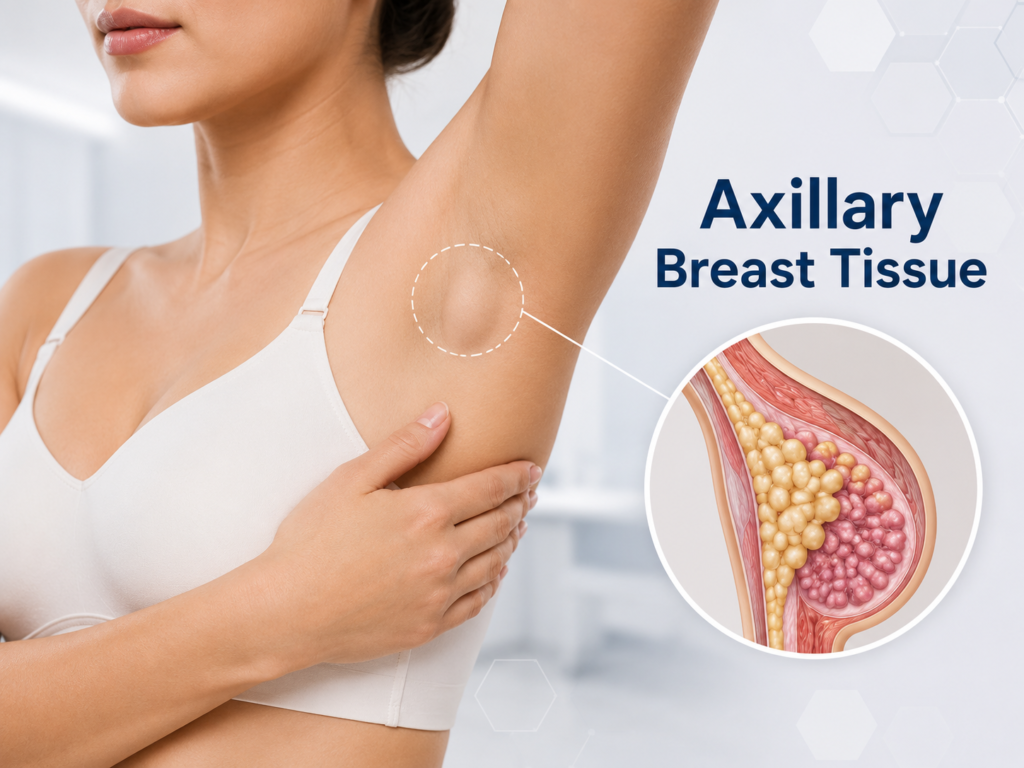
Many people notice a soft lump, fullness, or bulge under the arm and wonder whether it is excess fat or something more. In many cases, this condition may be axillary breast tissue, also known as accessory breast tissue. Although it is usually harmless, it can cause discomfort, swelling, pain during hormonal changes, and cosmetic concerns that affect confidence.
For many individuals, axillary breast tissue removal offers a safe and effective solution to improve comfort and achieve a smoother underarm contour. Whether the concern is caused by glandular tissue, fatty tissue, or a combination of both, modern cosmetic surgery provides personalised treatment options with natural-looking results.
This guide explains everything you need to know about axillary breast tissue, including its causes, symptoms, diagnosis, treatment options, axillary breast tissue removal surgery, liposuction for axillary breast tissue, recovery time, and frequently asked questions.
Axillary breast tissue is additional breast tissue that develops in the underarm (axilla). During fetal development, breast tissue forms along a structure known as the milk line, which extends from the armpits to the groin. Normally, this tissue disappears except in the chest area. However, in some individuals, a portion remains in the underarm, resulting in axillary breast tissue.
Unlike ordinary fat, accessory breast tissue contains glandular breast tissue that responds to hormonal changes. This means it may enlarge, become tender, or feel swollen during puberty, menstruation, pregnancy, or breastfeeding.
Many people mistake this condition for stubborn underarm fat, but it is a distinct medical condition that often requires specialist evaluation.
The primary cause of axillary breast tissue is incomplete regression of the embryonic milk line during fetal development. This is a congenital condition, meaning it develops before birth.
Several factors can make the tissue more noticeable later in life.
Hormonal fluctuations during puberty, pregnancy, breastfeeding, and menopause can increase the size of axillary breast tissue.
Some individuals may have a family history of accessory breast tissue, making them more likely to develop the condition.
Weight gain may increase the surrounding fatty tissue, making the underarm bulge appear larger. However, losing weight alone may not eliminate true glandular breast tissue.
Many women notice that axillary breast tissue becomes more prominent during pregnancy and breastfeeding because it responds to hormonal stimulation just like normal breast tissue.
Symptoms vary from person to person depending on the amount of tissue present.
Common symptoms include:
Some patients experience no symptoms other than the visible bulge, while others may develop discomfort during daily activities or exercise.
One of the most common questions patients ask is, “Is axillary breast tissue dangerous?”
In most cases, axillary breast tissue is not dangerous. It is a benign condition that does not pose a serious health risk. However, because it contains breast tissue, it can develop the same benign or, rarely, malignant conditions as normal breast tissue.
You should consult a qualified plastic surgeon or breast specialist if you notice:
Early evaluation helps rule out other medical conditions and ensures appropriate treatment.
A proper diagnosis is essential before deciding on treatment.
Your surgeon may recommend:
The first step involves examining the underarm to determine whether the swelling is caused by glandular tissue, fat, or another condition.
Ultrasound is commonly used to confirm the presence of accessory breast tissue and rule out enlarged lymph nodes or cysts.
Women above the recommended screening age or those with specific concerns may require mammography.
MRI is rarely needed but may be recommended for complex cases.
After evaluation, your surgeon will determine whether axillary breast tissue treatment is necessary.
Many patients ask, “Does axillary breast tissue go away with exercise?”
Exercise is excellent for improving overall fitness and reducing body fat. However, true axillary breast tissue does not usually disappear with exercise alone because it contains glandular tissue rather than only fat.
Similarly, people often search for “how to get rid of axillary breast tissue.” While maintaining a healthy weight can improve the appearance of surrounding fat, persistent glandular tissue generally requires medical treatment if it causes cosmetic or physical concerns.
For patients whose underarm fullness is primarily fatty tissue, lifestyle changes may offer some improvement. However, when glandular breast tissue is present, surgical treatment often provides the most effective and long-lasting results.
Not everyone with accessory breast tissue requires surgery. However, axillary breast tissue removal may be considered if the condition causes:
A consultation with an experienced plastic surgeon helps determine whether surgery is the right option based on your symptoms, anatomy, and aesthetic goals.
The axillary breast tissue removal recovery time varies depending on the procedure performed and individual healing ability. Most patients can return to normal activities within a short period, while complete healing may take several weeks.
Following your surgeon’s instructions, wearing recommended garments, and attending follow-up appointments can support a smoother recovery. If glandular tissue is present, axillary breast tissue removal surgery may be recommended. The procedure removes excess breast tissue through a small incision hidden in the underarm crease, creating a smoother and more defined appearance. In some cases, surgery may be combined with liposuction of axillary breast tissue for optimal results.
The axillary breast tissue removal recovery in Bangalore. time varies depending on the procedure and individual healing. Most patients can return to light daily activities within a few days, while complete axillary breast tissue surgery recovery usually takes a few weeks. Following your surgeon’s aftercare instructions helps ensure a smooth axillary breast tissue removal recovery and the best possible outcome.
Liposuction for axillary breast tissue is ideal for patients with excess fatty tissue in the underarm area. This minimally invasive procedure removes unwanted fat through small incisions, improving the contour with minimal scarring and a faster recovery.
The right axillary breast tissue treatment depends on the amount of glandular tissue, excess fat, and your symptoms. After a thorough evaluation, your plastic surgeon will recommend the most suitable treatment for safe and natural-looking results.
Axillary breast tissue is a common condition that can cause discomfort, swelling, or cosmetic concerns. While it is usually harmless, many patients choose axillary breast tissue removal to improve comfort and achieve a smoother underarm contour. Depending on your condition, liposuction for axillary breast tissue or axillary breast tissue removal surgery in Bangalore may be recommended. Consulting an experienced plastic surgeon can help you choose the most suitable treatment and understand the expected axillary breast tissue removal recovery time.
If you are considering axillary breast tissue treatment, schedule a consultation with Dr. Karishma Kagodu to receive a personalised evaluation and treatment plan.
Axillary breast tissue is a common condition that can cause discomfort, swelling, or cosmetic concerns. While it is usually harmless, many patients choose axillary breast tissue removal to improve comfort and achieve a smoother underarm contour. Depending on your condition, liposuction for axillary breast tissue or axillary breast tissue removal surgery may be recommended. Consulting an experienced plastic surgeon can help you choose the most suitable treatment and understand the expected axillary breast tissue removal recovery time.
If you are considering axillary breast tissue treatment in Bangalore, schedule a consultation with Dr. Karishma Kagodu to receive a personalised evaluation and treatment plan.
Axillary breast tissue is extra breast tissue that develops in the underarm area due to incomplete development of the milk line. It is also known as accessory breast tissue.
In most cases, axillary breast tissue is not dangerous. However, any unusual changes, sudden growth, pain, or discomfort should be evaluated by a medical professional.
Exercise and diet can help reduce overall body fat but cannot completely remove axillary breast tissue. Treatment options like liposuction or axillary breast tissue removal surgery may be recommended depending on the condition.
Axillary breast tissue removal can be performed through liposuction or surgical excision. The best method depends on the amount and type of tissue present.
Yes, liposuction for axillary breast tissue can be effective when excess fatty tissue is the main concern. It helps improve the contour of the underarm area with minimal scarring.