
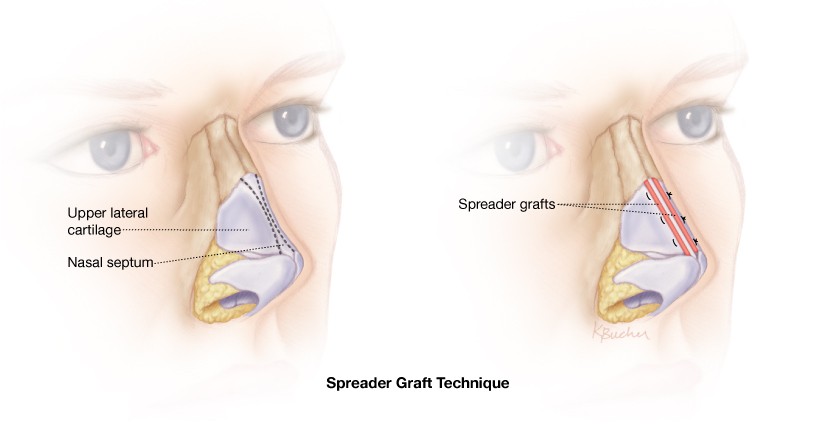
“Spreader grafts are a safe way to correct the crooked nose and improve breathing and are commonly placed during rhinoplasty, after hump removal, to prevent mid-nasal collapse!”
The use of spreader grafts is a standard procedure in rhinoplasty surgery to improve the aesthetic appearance and functionality of a nose. Usually, spreader grafting is employed during rhinoplasty surgery, after hump removal, to prevent mid-nasal collapse. Although the placement of spreader grafts in an open rhinoplasty is easy, it requires extreme precision and perfection for their positioning and stabilization in closed/endonasal rhinoplasty to attain consistent functional and aesthetic results.
According to Dr. Karishma Kagodu, MS, M CH., a board-certified plastic surgeon with expertise in rhinoplasty surgery in Bangalore, added that “the challenge of modern rhinoplasty surgery is to create a nose that looks aesthetically pleasing and balances with the individual’s face and ethnicity. And the advantage of using a septal spreader graft in an open rhinoplasty is that it allows a plastic surgeon to meet the best aesthetic and functional results, preventing mid-nasal collapse and improving breathing functions. In addition, the versatility of the external rhinoplasty approach (open) in septal spreader grafts helps perform accurate contouring and precise placement and suture stabilization to minimize postoperative graft displacement.”
Spreader grafts are small strips of cartilage or bone inserted next to the nasal septum on the dorsum (top) of the nose to perform aesthetic corrections and repair the middle nasal vault. Cartilage can be obtained from the septum, ear, or costal cartilage. In addition, spreader grafts are typically rectangular and measure 1-3 mm in thickness by 4-6 mm in width by 20-35 mm in length, depending on the individual’s nasal anatomy.
One must note that spreader grafts have both aesthetic and functional benefits in rhinoplasty surgery, as it helps improve breathing problems by preventing mid-nasal collapse and correcting the crooked middle third of the nose.
Placing a spreader graft helps prevent mid-nasal collapse and improves breathing functions for patients with internal nasal valve narrowing/complete obliteration of the valve angle or chronic nasal congestion. Subjective nasal obstruction can occur due to physical obstruction, collapse, septal deviation, or synechiae and is addressed with the spreader graft technique in rhinoplasty. Moreover, the most common cause of iatrogenic narrowing of the valve angle is hump reduction at the time of rhinoplasty, as reduction of a hump causes an unstable open roof in the cartilaginous dorsum with poor or no support for the upper lateral cartilages (ULCs), resulting middle vault collapse and presents crucial symptoms of nasal obstruction.
Thus, a spreader graft technique is reliable, effective, and quite efficient for treating nasal obstruction, improves airflow, and is widely used during a nose job as a preventive measure after hump reduction to maintain a wide nasal valve angle.
If you want to know more about rhinoplasty surgery or seeking a spreader graft technique to address breathing issues, call Dr. Karishma Kagodu, MS, M CH., at +91 8042036382, +91 9108969006, +91 7624809006 and schedule your consultation today.